NIST SP 800-82 Rev. 3: The OT Security Playbook
OT Cybersecurity Fundamentals — Estimated reading time: 8 minutes
Editorial note: This article discusses NIST SP 800-82 Rev. 3, published in September 2023. NIST initiated a revision process for SP 800-82 in January 2026; Rev. 4 is currently under development.
Introduction
In the previous articles, we discussed why OT cybersecurity cannot simply be treated as IT cybersecurity with industrial devices. We mapped the OT environment using the Purdue Model and looked at architectural levels, connections, and trust boundaries. Then we introduced the NIST Cybersecurity Framework (CSF) 2.0 as a common language for organizing and communicating cybersecurity risk.
But there is still a practical question:
How do we translate those cybersecurity objectives into decisions that make sense in an actual OT environment?
This is where NIST Special Publication 800-82 Rev. 3 becomes particularly useful.
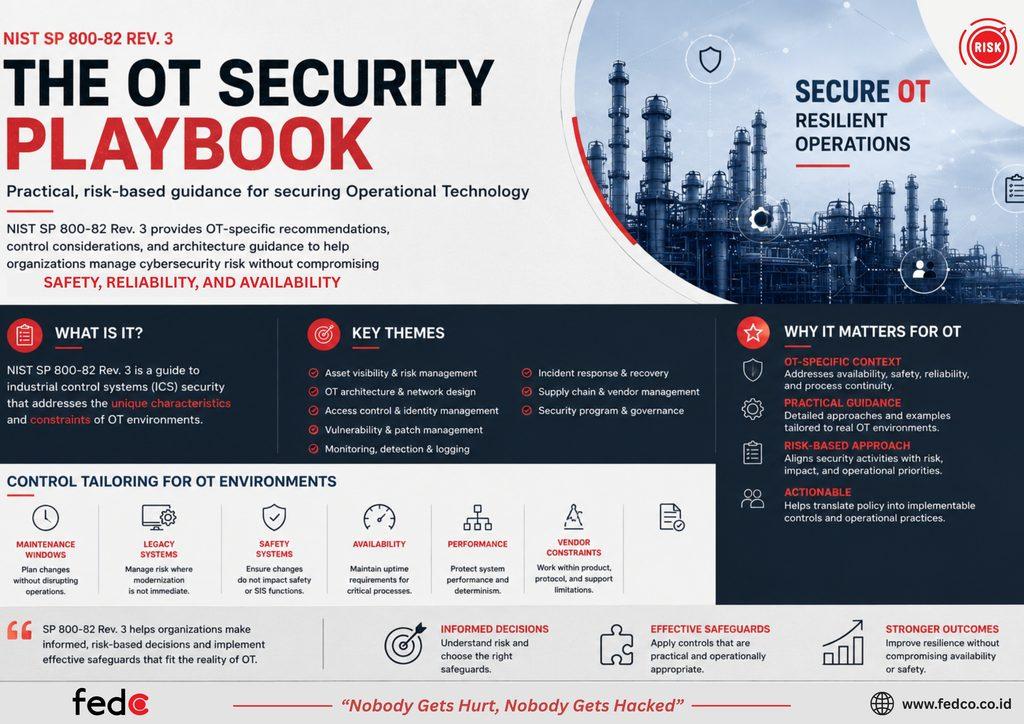
NIST SP 800-82 Rev. 3, Guide to Operational Technology (OT) Security, provides guidance for securing OT while addressing the environment’s unique performance, reliability, and safety requirements. It covers OT characteristics and topologies, threats and vulnerabilities, risk management, security practices, and recommended safeguards and countermeasures.
A simple way to think about the relationship is:
- CSF 2.0 helps organize the cybersecurity conversation
- NIST SP 800-82 helps make that conversation specific to OT
It is not a checklist that says every facility must implement exactly the same controls.
Instead, it provides a foundation for making risk-informed and OT-aware security decisions.
What Is NIST SP 800-82 Rev. 3?
NIST SP 800-82 was originally developed to address the security of Industrial Control Systems.
Rev. 3 expanded the scope from ICS to the broader category of Operational Technology (OT).
NIST defines OT broadly as programmable systems or devices that interact with the physical environment, including systems that monitor or control devices, processes, and events. Examples include industrial control systems, building automation, transportation systems, physical access control, and environmental monitoring systems.
The third revision also introduced or expanded guidance around:
- OT threats and vulnerabilities
- OT risk management
- OT architectures
- Security practices
- Security capabilities and tools
- Alignment with the NIST Cybersecurity Framework
- Tailoring of NIST SP 800-53 security controls
- An OT Overlay for SP 800-53 Rev. 5 controls
This makes SP 800-82 particularly useful as a bridge between cybersecurity governance and technical OT implementation.
The Six Themes to Understand
Rather than reading SP 800-82 as a long list of security recommendations, it is useful to understand the major areas it addresses.
A simplified view is:
| Theme | What it helps answer |
| OT Overview | What makes OT different from conventional IT systems? |
| Threats & Vulnerabilities | What can go wrong and how might OT be exposed? |
| Risk Management | How should cybersecurity risk be evaluated and prioritized? |
| OT Architectures | How are OT systems typically structured and connected? |
| Security Program Practices | What organizational and operational practices support OT security? |
| Security Controls & Countermeasures | What safeguards can help reduce identified risks? |
These themes should not be treated as isolated topics.
They connect together.
For example:
Architecture → Exposure → Threat → Vulnerability → Probability and Consequence → Risk → Safeguard
That sequence is important.
A control should not be selected simply because it is considered a “good cybersecurity practice.”
The organization should first understand what risk the control is intended to reduce and how the control will behave in the OT environment.
OT Security Starts with Context
One of the most important ideas behind SP 800-82 is that OT security has to consider more than cybersecurity alone.
OT systems often have requirements around:
- Performance
- Reliability
- Availability
- Safety
- Timing
- Deterministic behavior
- Long operational lifecycles
- Vendor dependencies
- Maintenance constraints
NIST explicitly frames OT security around these unique performance, reliability, and safety requirements.
That means a security decision cannot always be evaluated using the same assumptions used in an office IT environment.
Consider a simple example.
An IT vulnerability scanner identifies an old operating system that has known vulnerabilities.
The immediate reaction might be:
“Patch it immediately.”
That may be reasonable for a standard business endpoint.
But what if the same operating system is running an engineering workstation connected to a critical control system?
Before applying the patch, the OT team may need to understand:
- Is the system currently supporting production?
- Is the patch compatible with the control application?
- Has the vendor validated it?
- Is there a maintenance window?
- Is a backup available?
- Can the system be restored if the patch fails?
- What happens to the process if the workstation becomes unavailable?
- Is there a compensating control that can reduce the risk temporarily?
The question has changed from:
“Can we patch this vulnerability?”
to:
“How can we reduce this vulnerability risk without creating an unacceptable operational risk?”
That is the kind of thinking SP 800-82 is designed to support.
Control Tailoring: One Size does not Fit All
One of the most valuable concepts in OT cybersecurity is control tailoring.
A cybersecurity control may be appropriate in principle, but its implementation may need to change depending on the OT environment.
SP 800-82 Rev. 3 includes tailoring guidance for NIST SP 800-53 Rev. 5 controls and an OT Overlay providing additional OT-specific guidance. NIST describes the overlay as a partial tailoring of controls and security baselines for low, moderate, and high-impact OT systems, with supplementary OT-specific guidance.
This is important because security controls are not independent from the systems they protect.
Let’s look at several practical examples.
Example 1: Patching
Patching is a familiar cybersecurity activity.
But OT patching may involve:
Vulnerability identified → risk evaluated → vendor consulted → compatibility checked → backup confirmed → maintenance window scheduled → patch tested → operational validation → deployment → monitoring
The process can take longer than conventional IT patching.
That does not mean OT organizations should ignore vulnerabilities.
It means the remediation strategy needs to consider the operational environment.
If immediate patching is not possible, other risk-reduction measures may need to be considered.
For example:
- Network segmentation
- Restricted access
- Application whitelisting
- Monitoring
- Removal of unnecessary services
- Controlled remote access
- Increased logging
- Temporary isolation
The appropriate combination depends on the specific risk and system.
Example 2: Legacy Operating Systems
Long-lived OT environments can contain systems that cannot easily be upgraded.
A legacy operating system may be:
- No longer supported by its vendor
- Dependent on specialized software
- Running an older control application
- Connected to a controller or other critical asset
- Difficult to replace without a major shutdown
The answer cannot simply be:
“Replace it immediately.”
Replacement may require significant engineering work, procurement, testing, commissioning, and operational downtime.
Instead, the organization needs to understand the risk and determine appropriate compensating or mitigating measures.
Possible measures (compensating controls) may include:
- Network isolation
- Restricted communication paths
- Strong access controls
- Controlled remote access
- Application whitelisting
- Increased monitoring
- Removal of unnecessary services
- Dedicated maintenance procedures
- Critical spare parts availability
- Backup and restore management
Again, the objective is not to excuse outdated technology.
The objective is to manage the risk realistically while planning a sustainable lifecycle strategy.
Example 3: Safety Systems
Safety-related systems require particularly careful consideration.
A cybersecurity control should not unintentionally interfere with a safety function or create a new operational hazard.
For example, a proposed network change may look appropriate from a cybersecurity perspective.
But the engineering and safety teams may need to determine:
- Does the change affect a safety-related communication path?
- Could it affect availability of a protective function?
- What happens if the security device fails?
- Is the fail-safe behavior maintained?
- Has the change been tested?
- Is there a defined rollback procedure?
This is why cybersecurity changes affecting OT should be evaluated together with the appropriate engineering, operations, and safety stakeholders.
Cybersecurity is part of the risk picture.
It is not the only part.
Architecture Matters
In the article titled “Inside the Purdue Model: Mapping the OT Architecture” introduced the Purdue Model as a way of understanding OT architecture.
NIST SP 800-82 provides broader discussion of OT architectures and common system topologies, helping teams understand how different OT components and network arrangements can affect security decisions.
This creates an important connection between our earlier articles.
Article titled “Inside the Purdue Model: Mapping the OT Architecture”:
Where are the systems and how are they connected?
Link to this article: https://fedco.co.id/inside-the-purdue-model-mapping-the-ot-architecture/
Article titled “NIST Cybersecurity Framework (CSF) 2.0 Applied to OT”:
What cybersecurity outcomes should we achieve?
Link to this article: https://fedco.co.id/nist-cybersecurity-framework-csf-2-0-applied-to-ot/
This article:
How do we apply OT-specific security guidance while respecting the environment?
Architecture influences control decisions. For example, consider remote access. A remote connection to an OT environment might involve:
Vendor → Internet → Enterprise Network → Industrial DMZ → Jump Server → OT System
The security question is not simply:
“Do we allow remote access?”
Instead:
- Why is remote access required?
- Who needs it?
- What system needs to be accessed?
- When is access permitted?
- How is the user authenticated?
- Is privileged access controlled?
- Is the session monitored?
- Can access be disabled quickly?
- What happens if the remote-access infrastructure fails?
Architecture provides the context needed to answer these questions.
From Risk Identification to Control Selection
A useful way to apply SP 800-82 is to follow a structured sequence.
Step 1 — Understand the process
What does the system do?
What physical process does it support?
Step 2 — Understand the architecture
Where is the system located?
What does it communicate with?
What connections exist?
Step 3 — Identify threats and vulnerabilities
What could compromise the system?
What weaknesses or exposures exist?
Step 4 — Understand consequences
What could happen if the system becomes unavailable, altered, or compromised?
Consider:
- Human, Safety, and Environment
- Production Operations
- Financial Impact
- Business Reputation, etc.
Step 5 — Evaluate the risk
How likely is the scenario?
How severe could the consequence be?
Step 6 — Select appropriate safeguards
What controls or practices can reduce the risk?
Step 7 — Tailor the implementation
How should the control be implemented so that it works within the operational environment?
Step 8 — Validate the change
Can the change be safely tested?
Has engineering validated it?
Are operational and safety requirements satisfied?
Step 9 — Monitor and improve
Did the control actually reduce the intended risk?
This approach prevents cybersecurity controls from being selected in isolation.
Why Change Management Matters
One of the easiest mistakes in OT cybersecurity is treating a security change as “just an IT change.”
A firewall rule change, patch, endpoint configuration change, authentication modification, or monitoring deployment can affect OT dependencies.
Therefore, cybersecurity changes should be treated as controlled operational changes.
A practical change process may include:
Request → Risk Review → Engineering Review → Safety Review (where applicable) → Testing → Approval → Implementation → Validation → Monitoring → Documentation
The exact process will vary between organizations.
But the principle is consistent:
Do not assume that a technically correct security change is automatically an operationally safe change.
This is particularly important for systems supporting critical processes.
Operational Validation is not Optional
Imagine a security team successfully deploys a new firewall rule.
The firewall shows:
Rule applied successfully.
From a cybersecurity perspective, the change appears successful.
But what if:
- An HMI can no longer communicate with a required server?
- A Historian stops receiving data?
- An engineering workstation loses necessary connectivity?
- An alarm notification path is interrupted?
- A vendor support function no longer works?
The technical change may have succeeded while the operational objective failed.
This is why validation should include both:
Technical validation and Operational validation
The question should be:
“Did the security change achieve its intended cybersecurity objective without creating an unacceptable operational consequence?”
Don’t Forget Recovery
Control implementation is only one side of the equation.
Before making a significant OT change, teams should also think about:
What happens if the change does not work?
This is where backup and rollback planning become important.
A practical change plan should consider:
- What needs to be backed up?
- Has the backup been verified?
- Can the previous configuration be restored?
- How long would restoration take?
- Who is authorized to perform the rollback?
- What operational state should be restored?
- How will the system be validated afterward?
The ability to recover is part of cybersecurity resilience.
NIST has also continued developing OT-specific backup guidance, including the publication of SP 1339, OT Backup Quick Start Guide, in June 2026.
SP 800-82 is not a Checklist
This point deserves emphasis.
SP 800-82 provides guidance and recommended safeguards, but it should not be treated as:
“Find every recommendation and implement everything.”
A security control is valuable when it addresses a meaningful risk.
For example, an organization may identify a critical OT workstation with a vulnerable operating system.
The appropriate response might involve several measures rather than a single control:
Segmentation + Restricted Access + Monitoring + Controlled Maintenance + Backup + Eventual System Replacement
Another system may require a completely different approach.
This is why risk-based tailoring matters.
NIST’s earlier ICS guidance explicitly emphasized that recommended safeguards should be tailored to specific systems and their security, business, and operational requirements, rather than being used purely as a checklist. The Rev. 3 approach continues this OT-specific, risk-based direction.
How SP 800-82 Connects with CSF 2.0
We can now connect Articles “NIST Cybersecurity Framework (CSF) 2.0 Applied to OT” and this article.
NIST CSF 2.0
Provides a high-level language for cybersecurity risk management.
NIST SP 800-82 Rev. 3
Adds OT-specific context, architecture considerations, threats, vulnerabilities, safeguards, and control-tailoring guidance.
A simplified relationship looks like this:
| Question | Useful reference |
| How should we organize cybersecurity risk? | NIST CSF 2.0 |
| What is unique about OT? | NIST SP 800-82 Rev. 3 |
| What threats and vulnerabilities should we consider? | SP 800-82 Rev. 3 |
| How should OT architecture influence security? | SP 800-82 Rev. 3 + OT Architecture Analysis |
| How should controls be tailored? | SP 800-82 Rev. 3 |
| How should industrial systems be designed and security requirements defined? | IEC 62443 |
A Practical Way to Use NIST SP 800-82
Organizations do not need to start by reading the entire publication and attempting to implement every recommendation.
A more practical approach is:
Start with one system or process.
1. Map the system – Understand its architecture and dependencies.
2. Understand the process – Determine what the system actually does.
3. Identify threats and vulnerabilities – Look at technical and operational exposures.
4. Understand consequences – Consider safety, reliability, production, environmental, and financial impacts.
5. Review relevant NIST SP 800-82 guidance – Identify safeguards that could reduce the identified risks.
6. Tailor the controls – Adapt them to the actual technology and operational constraints.
7. Validate before implementation – Involve operations, engineering, maintenance, cybersecurity, and safety stakeholders as appropriate.
8. Implement and monitor – Verify that the control works as intended.
9. Review the result – Did the risk actually decrease?
This creates a repeatable process rather than a one-time compliance exercise.
Key Takeaway
NIST SP 800-82 Rev. 3 is valuable because it brings OT context into cybersecurity decision-making.
It reminds us that OT security must consider:
Architecture + Production Operations + Risk (Safety + Reliability + Availability) + Cybersecurity
A control that looks excellent on paper may not be appropriate if it disrupts the process it is supposed to protect.
The goal is therefore not:
“Implement as many cybersecurity controls as possible.”
The goal is:
“Select and tailor appropriate safeguards that reduce cybersecurity risk while respecting the operational environment.”
A simple way to remember the progression so far is:
Article “Why OT Cybersecurity Is Not IT Cybersecurity: Where Cyber Risk Meets the Physical World” — Understand the difference.
Why OT cybersecurity is different from IT cybersecurity.
Article “Inside the Purdue Model: Mapping the OT Architecture” — Understand the architecture.
Where OT systems sit and how they connect.
Article “NIST Cybersecurity Framework (CSF) 2.0 Applied to OT” — Organize the risk.
Use NIST CSF 2.0 as a common cybersecurity language.
This article — Apply OT-specific guidance.
Use NIST SP 800-82 Rev. 3 to bring OT context into security decisions.
And now we are ready to move from guidance toward industrial security architecture and requirements.
Next in the OT Cybersecurity Fundamentals
IEC 62443: From OT Security Guidance to Industrial Security Architecture
The next article will introduce the IEC 62443 family and explain how it approaches industrial automation and control system security through concepts such as:
- Roles and responsibilities
- Security lifecycle
- Zones and conduits
- Security requirements
- Risk-based security levels
If NIST CSF 2.0 gives us the risk-management language, and NIST SP 800-82 gives us OT-specific guidance, IEC 62443 brings us closer to the question:
How should security requirements actually be structured within an industrial automation and control system?
That is where the next part of the journey begins.
References
- NIST SP 800-82 Rev. 3 — Guide to Operational Technology (OT) Security, September 2023.
- NIST Operational Technology Security Project.
- NIST SP 800-53 Rev. 5 Operational Technology Overlay, referenced in SP 800-82 Rev. 3 Appendix F.
- NIST SP 800-82 Rev. 4 — Initial Preliminary Draft / Pre-Draft Call for Comments, January 2026.
Note: This article intentionally focuses on SP 800-82 Rev. 3, which remains the published final edition. NIST’s Rev. 4 revision process is acknowledged here for currency but is not treated as established final guidance.